
Research Highlight
Cutting the Fuel Line of Cancer Stem Cells: Targeting Glutamine Metabolism
Cancer stem cells survive treatment partly because of how they feed themselves. Why many of them depend on glutamine, which drugs block that pathway, and what has and has not worked so far.
Published
Why metabolism matters for cancer stem cells
Cancer stem cells (CSCs) are the rare cells in a tumor that can renew themselves, spread, and survive treatment. They are a major reason tumors come back after chemotherapy or radiotherapy, as we describe in our article on cancer stem cells. Finding what they depend on, and cutting it off, is one way to reach them.
One place to look is metabolism. Compared with the bulk of the tumor, CSCs switch flexibly between burning glucose through glycolysis and using oxygen-based respiration, and they lean on other fuels too, including fatty acids and an amino acid called glutamine. In 2022 we published a review in the International Journal of Molecular Sciences, Therapeutic Targeting of Glutaminolysis as a Novel Strategy to Combat Cancer Stem Cells, which gathers what is known about this dependence and the drugs aimed at it. This article is a plain-language guide to it. The original is a narrative review of the literature, not a new experiment, so the findings below come from the studies it cites.
What "glutaminolysis" means
Glutamine is the most abundant amino acid in the blood. Cells take it in through transporters on their surface, mainly one called SLC1A5 (also known as ASCT2). Inside the cell, an enzyme called glutaminase (GLS1 or GLS2) converts glutamine to glutamate, which is then turned into α-ketoglutarate and fed into the TCA cycle, the cell's central energy and building-block pathway. This chain is glutaminolysis. Branches of it also supply fatty acids, the reducing power NADPH, and the raw material for nucleotides.
Many cancer-driving genes push cells toward this pathway. MYC, for example, raises the levels of both the glutamine transporter and glutaminase, and KRAS, TP53 changes, and PI3K/mTOR signaling all influence how much a tumor depends on glutamine.
Why CSCs lean on glutamine
The review argues that for CSCs glutamine is not only about energy. It is also about survival under attack:
- Antioxidant defense. Glutamine feeds the production of glutathione, which neutralizes the reactive oxygen species that damage cells and can also bind platinum drugs, lowering how much drug stays inside the cell. Keeping oxidative stress low is also tied to keeping the stem-like state.
- DNA repair. Nucleotides made from glutamine help repair the DNA damage that chemotherapy causes.
- Growth signaling. Glutamine helps switch on mTORC1, a master growth regulator.
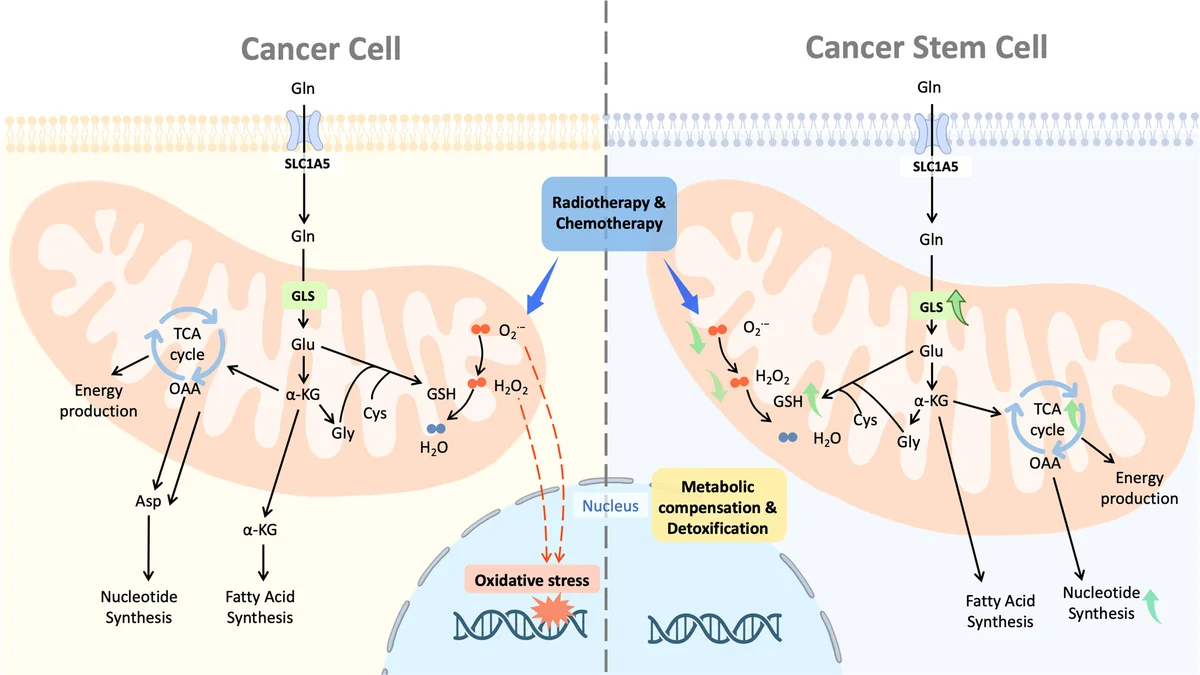
Researchers have found glutamine-dependent CSCs in several tumors. In radioresistant prostate cancer stem cells, removing glutamine or inhibiting MYC or glutaminase made the cells sensitive to radiation again, and high MYC and glutaminase levels predicted worse progression-free survival in patients treated with radiotherapy. In triple-negative breast cancer stem cell lines, glutaminase inhibitors cut stemness markers by about 70–80% and reduced sphere formation. Related findings have been reported in glioblastoma, liver, colorectal, pancreatic, head and neck, and other cancers.
Drugs that block the pathway
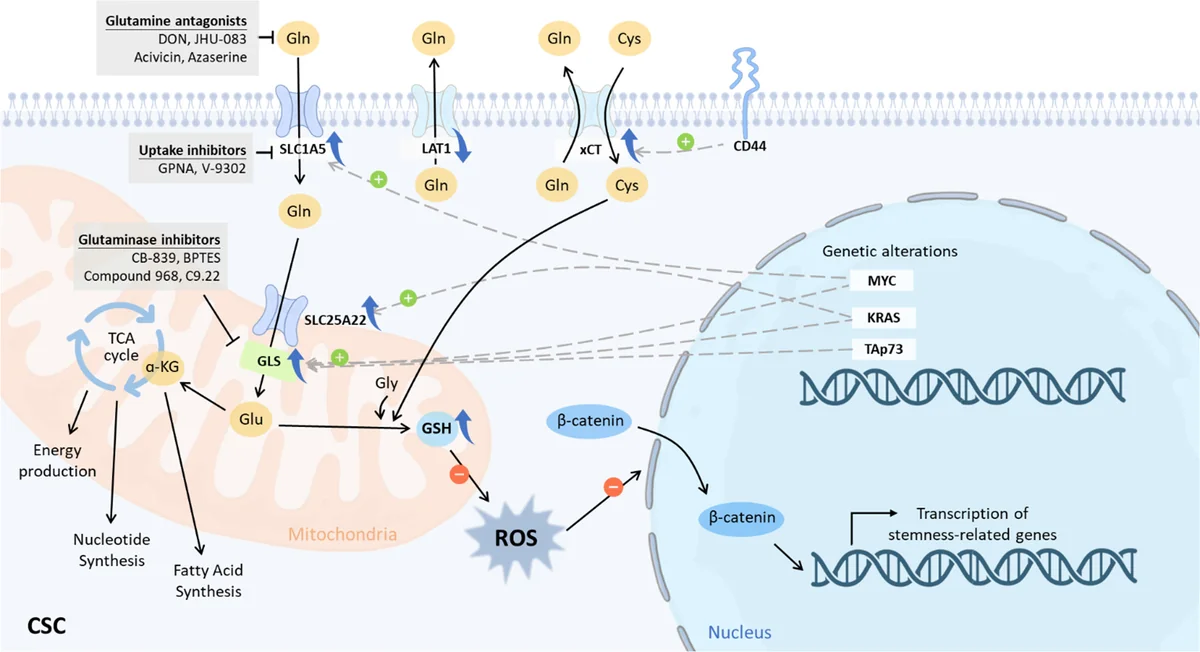
The review sorts the approaches into four groups:
- Glutaminase inhibitors. BPTES was an early selective inhibitor but dissolves poorly, which limited its use in animals. Packaging it in nanoparticles improved this. CB-839 (telaglenastat) is the best studied in patients. Compound 968 blocks both forms of the enzyme and worked in breast cancer that resisted BPTES. C9.22 came from a screen of about 30,000 compounds.
- Glutamine antagonists. Older drugs such as DON stopped tumor growth but were too toxic. A newer prodrug, JHU083, is activated mainly inside tumors, which reduces exposure of the gut.
- Transporter blockers. GPNA and V-9302 aim to stop glutamine from entering cells, but they are not specific enough, and no truly selective SLC1A5 inhibitor has been found.
- Glutamine depletion. Enzymes that remove glutamine from the circulation have been tried, but tumors can respond by making their own glutamine.
What the clinical trials show
CB-839 has been tested mostly in metastatic renal cell carcinoma, and most trials reported manageable side effects. Early phase I and II studies suggested added benefit when it was combined with cabozantinib or everolimus. However, a randomized phase II trial found that CB-839 plus cabozantinib did not improve progression-free survival compared with placebo plus cabozantinib. These trials were not designed to target cancer stem cells, so they do not answer the CSC question directly. At present, no glutaminolysis inhibitor is established as a standard treatment.
Combinations, and a caution
Because tumors adapt, a single drug is unlikely to be enough. In preclinical work, glutaminase inhibitors combined with metformin gave stronger effects than either alone, including in a patient-derived pancreatic cancer model, and combinations with PARP inhibitors or chemotherapy also looked promising. There is a caution on the immunotherapy side: in a mouse model of lung cancer, CB-839 impaired the expansion of CD8 T cells, so pairing it with anti-PD1 therapy may work against itself. Several trials are testing that combination.
What we still need to learn
The authors point to several open questions:
- Plasticity. CSCs can switch to other fuels or make glutamine themselves, which limits drugs that hit only one step.
- Selectivity. Normal stem cells use these pathways too, so we need to understand what is different about CSCs to protect healthy tissue.
- Biomarkers. Glutaminase levels might help choose which patients to treat, but that has to be tested prospectively.
- Evidence. Most CSC findings are from cell lines, spheroids and mice.
The authors see glutamine-targeted drugs as an add-on to standard treatment, aimed especially at preventing recurrence and metastasis. This connects to our other work: in our review of the transcription factor PBX1, PBX1 turns out to increase glutamine metabolism, one more way a master regulator can tie stemness to metabolism.
If you are a prospective student interested in cancer metabolism, or a researcher who would like to collaborate, see our Join us page. The full review is open access.
Reference: Kao T-W, Chuang Y-C, Lee H-L, Kuo C-C, Shen Y-A. Therapeutic targeting of glutaminolysis as a novel strategy to combat cancer stem cells. Int J Mol Sci. 2022;23(23):15296. DOI · PubMed Central