
Research Highlight
PBX1: A Master Switch Upstream of Cancer Cell Fate
A transcription factor first found in childhood leukemia turns out to sit near the top of many cancer pathways. What PBX1 does, why it predicts poor outcomes in several tumors, and how researchers are trying to drug it.
Published
A protein found in leukemia, needed for life
In 1990, researchers studying a form of childhood leukemia noticed that the gene E2A had been fused to a then-unknown partner. That partner was PBX1, a transcription factor, meaning a protein that switches other genes on and off. It was first called Prl and later renamed PBX1 to avoid confusion with prolactin.
PBX1 is not an oddity that only cancer cells use. It belongs to a family of conserved proteins that shape the body plan of the embryo, and mice that lack it die before birth with malformations in many organs and in the skeleton. In other words, PBX1 is a normal developmental tool, and cancer cells appear to borrow it.
What makes PBX1 unusual is where it acts. It is a pioneer factor: it can bind DNA that is tightly packed in closed chromatin and help open it, so that other transcription factors can follow. In estrogen receptor (ER)-positive breast cancer, for example, PBX1 binds regions of chromatin carrying a specific histone mark and makes them accessible, and the activity of PBX1 alone is enough to separate patients with different outcomes. A factor that works at that level can influence a great many downstream decisions, which is why we and others describe it as a master regulator near the top of the cell-fate hierarchy.
What PBX1 does inside a tumor
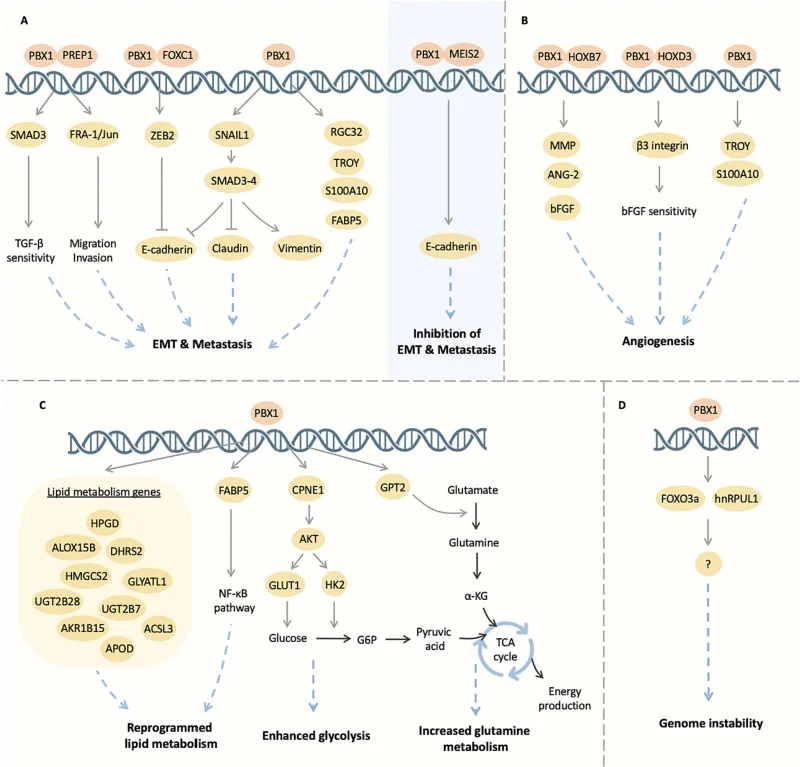
Our group and collaborators recently wrote a review of the field, PBX1 as a novel master regulator in cancer, published in Biochimica et Biophysica Acta – Reviews on Cancer (2024). It brings together studies across about twenty cancer types. The picture that emerges is that PBX1 touches almost every hallmark of cancer:
- Growth and survival: it promotes proliferation and helps cells resist programmed cell death.
- Invasion and metastasis: it drives epithelial–mesenchymal transition (EMT), the change that lets tumor cells detach and move, through partners such as ZEB2 and SNAIL1.
- Blood supply: it contributes to angiogenesis, the growth of new vessels that feed a tumor.
- Metabolism: it reprograms lipid metabolism, glucose use and glutamine use.
- Genome stability and immune evasion: it has been linked to genomic instability and to how tumors avoid the immune system.
- Stemness and drug resistance: it supports cancer stem cell properties and chemoresistance, which is the link to our broader work on tumor recurrence.
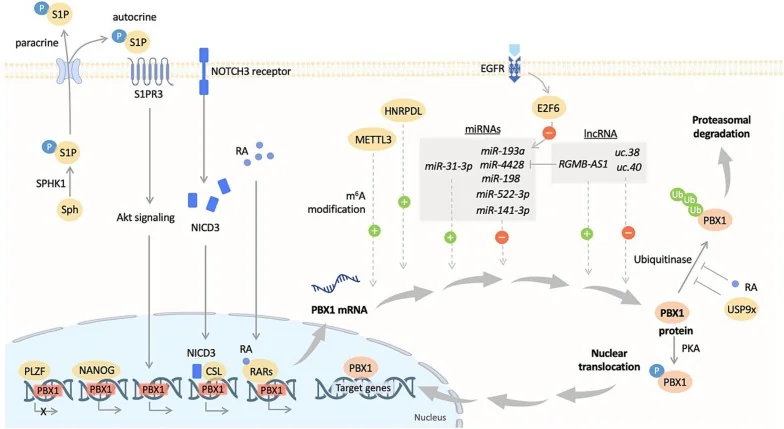
PBX1 itself is tightly controlled, at three levels: how much of its messenger RNA is made, how that RNA is regulated by microRNAs, long non-coding RNAs and chemical modifications, and how the finished protein is modified, moved into the nucleus or degraded. When any of these controls fails, PBX1 can end up overactive. The non-coding RNA layer is especially interesting because it offers potential handles for treatment.
A marker of risk in several cancers
Because PBX1 sits at a crossroads, its level can tell us something about a patient's outlook. Studies summarized in the review found that:
- In ER-positive breast cancer, high PBX1 was associated with shorter relapse-free survival (hazard ratio about 1.2 overall, and 1.37 in luminal B tumors).
- In ovarian cancer, in our own earlier work, patients with PBX1 overexpression had a median survival of 26 months, compared with 39 months for those without. PBX1 was also higher in recurrent, chemoresistant tumors than in the matched primary tumors.
- In multiple myeloma, high PBX1 tracked with a lower probability of survival in two independent datasets, and with advanced and relapsed disease.
- In acute lymphoblastic leukemia (ALL), the E2A-PBX1 fusion occurs in roughly 5% of B-cell ALL and has been linked to higher risk in adults and to central nervous system relapse.
The picture is not uniform. In neuroblastoma and in clear cell renal carcinoma, different studies have reached opposite conclusions about whether high PBX1 is good or bad, probably because of different methods and sample types. The authors call for larger studies. PBX1 is a promising marker, not yet a routine clinical test.
Can PBX1 be drugged?
Transcription factors were long considered "undruggable". They do their work by touching DNA and other proteins rather than by running chemical reactions, so their surfaces are flat and offer few pockets for a drug to grip. PBX1 has two features that make it attractive anyway: its level is low in most normal adult tissues compared with tumors, and it supports the stem-like, drug-resistant behavior that makes cancers return.
The review describes four strategies, all of which are still at the laboratory stage:
- Targeting what controls PBX1. Some microRNAs and long non-coding RNAs lower PBX1. Restoring them reduced tumor growth in animal models, for example miR-198 in pancreatic cancer. The difficulty is delivering RNA-based drugs in the clinic.
- Blocking PBX1's partners. PBX1 often works as a pair with HOX proteins. Peptide inhibitors such as HXR9 and its improved version HTL-001 prevent that pairing and cause cancer cells to die in many tumor types, and ICT-9119 is a small-molecule version. HTL-001 killed glioblastoma cells within hours, and the effect was even stronger in cancer stem cells. A related approach targets the PBX1–MEIS1 pair that drives some leukemias.
- Blocking PBX1 from binding DNA. The small molecule T417, which our group designed and tested, docks into a pocket on PBX1 that reads its DNA target sequence. In ovarian cancer models, it slowed tumor growth and made carboplatin-resistant cells sensitive to carboplatin again. It also reduced the viability of cell lines carrying an extra copy of the long arm of chromosome 1 (1q), a common change in several high-risk cancers, and shrank myeloma tumors in mice without visible adverse effects.
- Targeting the E2A-PBX1 fusion in leukemia, with an antibody–oligonucleotide conjugate or with drugs aimed at proteins downstream of the fusion, such as idelalisib.
Most of this evidence comes from cultured cells and mouse models. T417, HXR9, HTL-001 and ICT-9119 showed promising preclinical results and are waiting to move toward clinical trials. None of them is available to patients today.
What we still don't know
The authors name three gaps. First, PBX1 has been studied in different diseases with different methods, so there is no single model of how its many pathways fit together. Second, although PBX1 clearly acts as a pioneer factor, how it opens silent chromatin is still unclear. Third, most therapeutic findings are preliminary and need testing in animals and in patients.
These open questions are exactly where we are working. If you are a prospective student interested in transcription factors, cancer stem cells or drug discovery, or a researcher who would like to collaborate on PBX1, we would like to hear from you. See our Join us page, or read the full review, which is open access.
Reference: Kao T-W, Chen H-H, Lin J, Wang T-L, Shen Y-A. PBX1 as a novel master regulator in cancer: Its regulation, molecular biology, and therapeutic applications. Biochim Biophys Acta Rev Cancer. 2024;1879(2):189085. DOI · PubMed